
OEM Konjac Rice for Indonesia: What Should Importers Ask Before Placing an Order?
Indonesia's healthy food market is creating new opportunities for konjac rice, shirataki rice and Beras Porang products. As consumer interest in convenient and health-oriented food continues to develop, more Indonesian importers, distributors, e-commerce sellers and food brands are considering konjac rice as a new product category.
However, finding a supplier is only the beginning.
For an importer planning an OEM konjac rice project, the real challenge is choosing a supplier that can deliver the right combination of product quality, cost, packaging flexibility, documentation, MOQ and long-term supply stability.
A low quotation may look attractive at first, but it does not necessarily mean a successful product launch.
Before placing an order, Indonesian buyers should ask the following questions.
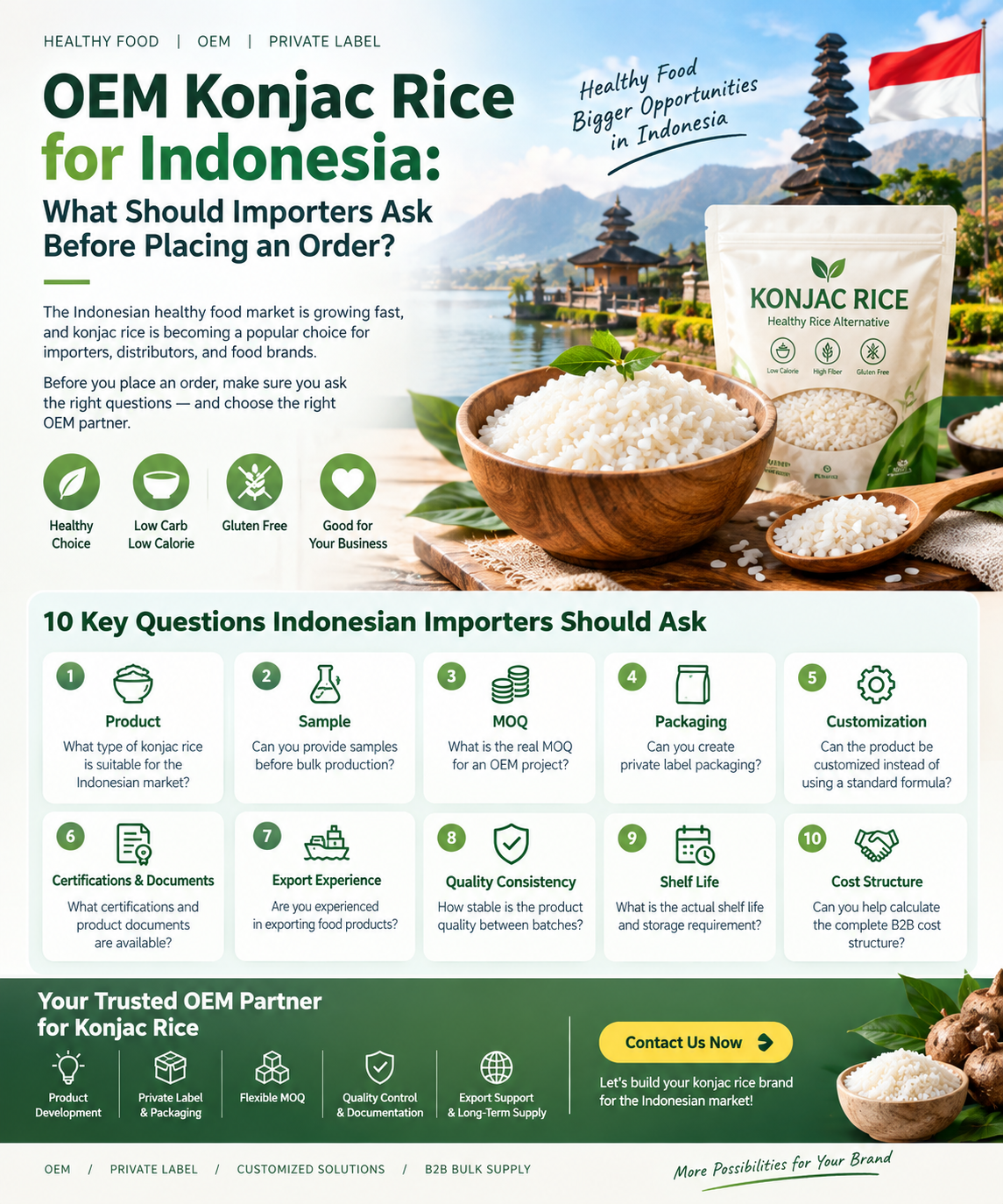
1. What Type of Konjac Rice Is Suitable for the Indonesian Market?
“Konjac rice” is not a single standardized product concept.
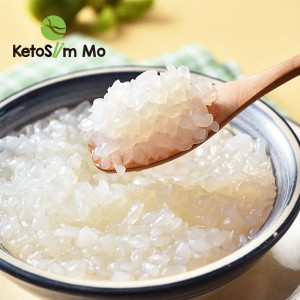
Different formulas can provide different textures, preparation methods, grain appearances and market positioning.
An importer should first determine what type of customer the product is designed for.
For example:
Everyday healthy rice alternative
Diet-focused food
Low-carb product line
Fitness-oriented food
High-fiber product
Instant meal solution
Premium healthy food
E-commerce trial product
This decision affects the product formula, packaging size, pricing strategy and sales channel.
For Indonesian brands, products can also be developed around local eating habits rather than simply copying products from other markets.
For example, a brand may consider an Instant Konjac Rice format for busy consumers or a rice-style product designed to pair with popular Indonesian dishes.
The right OEM supplier should be able to discuss these possibilities before production begins.
2. Can the Supplier Provide Samples Before Bulk Production?
Never evaluate a food supplier based only on photographs or a quotation.
A serious importer should request samples and evaluate the actual product.
Important factors include:
Appearance
Does the dry rice have a consistent grain shape and color?
Texture
Does the prepared product provide an acceptable eating experience?
Aroma
Is the characteristic konjac aroma controlled appropriately?
Preparation
Is the preparation process convenient and easy for the target consumer?
Packaging
Does the package look suitable for the Indonesian retail market?
A sample is not simply a free product.
It is the first stage of quality control and product development.
A professional supplier should be willing to discuss sample specifications and make reasonable adjustments before the final product is confirmed.
3. What Is the Real MOQ for an OEM Project?
MOQ is one of the most important questions for Indonesian importers.
However, buyers should not ask only:
“What is your MOQ?”
They should also ask:
- Is the MOQ based on finished products or packaging?
- Is there a different MOQ for standard and customized formulas?
- What is the MOQ for printed packaging?
- Can a trial order be arranged?
- Can different SKUs be combined?
- What happens when the brand scales up?
For emerging Indonesian food brands, an excessively large first order can create unnecessary inventory pressure.
A more practical strategy is to test the market with a controlled initial order and increase production after receiving customer feedback.
This is especially useful for e-commerce brands that need to validate product-market fit before committing to large inventory.
4. Can the Supplier Create Private Label Packaging?
For a new Indonesian brand, packaging is more than a container.
It is part of the product positioning.
A supplier should be able to discuss packaging formats such as:
Stand-up pouches
Individual sachets
Printed pouches
Color boxes
Multi-packs
Family-size packages
Customized retail packaging
Different formats can target different channels.
For example:
40g–50g sachet → trial purchase, individual serving and e-commerce
100g–300g package → personal consumption and retail
1kg package → family use, wholesale and foodservice
The importer should also confirm whether the manufacturer can support artwork development, packaging specifications and production coordination.
5. Can the Product Be Customized Instead of Using a Standard Formula?
This is where a true OEM manufacturer can create more value than a simple trading supplier.
Indonesian brands may want to differentiate their products through:
- Grain appearance
- Texture
- Ingredient combinations
- Portion size
- Preparation method
- Product positioning
- Packaging format
Potential product concepts may include:
Konjac Rice with Chia Seeds
Purple Sweet Potato Konjac Rice
High-Protein Konjac Rice
The goal is not to launch every variation.
The goal is to find a product concept that gives a particular Indonesian brand a reason to be different.
6. What Certifications and Product Documents Are Available?
For imported food products, documentation should be discussed before the purchase order—not after production.
Indonesian importers should ask the supplier what supporting documents can be provided, such as:
- Product specification
- Ingredient list
- Nutrition information
- Certificate of Analysis
- Microbiological test reports
- Shelf-life information
- Certificate of Origin where applicable
- Food safety certifications
- Halal-related documentation
- Packaging specifications
Importers should also verify the local requirements applicable to their specific product and sales channel.
For Indonesian projects, it is particularly important to clarify the documentation needed for local registration, labeling and compliance before finalizing the packaging artwork.
A responsible manufacturer should provide accurate product information and supporting documents rather than making unrealistic promises about regulatory approval.
7. Is the Supplier Experienced in Exporting Food Products?
A manufacturer may produce a good product but still be difficult to work with internationally.
Importers should ask:
- Which countries does the supplier export to?
- Can export documentation be provided?
- How are production and inspection handled?
- How is the product packed for international transportation?
- What is the expected lead time?
- How are repeat orders managed?
Export experience matters because an OEM project involves much more than manufacturing.
It involves:
Product → Packaging → Documentation → Production → Inspection → Logistics → Delivery
A supplier familiar with international B2B projects can help reduce communication gaps and unexpected problems.
8. How Stable Is the Product Quality Between Batches?
One successful sample does not guarantee a successful long-term product.
This is one of the most overlooked questions when choosing a supplier.
Indonesian importers should ask how the manufacturer controls:
- Raw materials
- Formula consistency
- Production parameters
- Finished-product inspection
- Packaging quality
- Batch traceability
For a private label brand, consistency is critical.
If the first shipment performs well but the second shipment has a noticeably different texture or appearance, customer trust can quickly decline.
The supplier should therefore have a clear quality-control process from raw materials to finished products.
9. What Is the Actual Shelf Life and Storage Requirement?
Shelf life directly affects inventory planning and import costs.
Before ordering, buyers should confirm:
- Shelf life
- Recommended storage conditions
- Packaging requirements
- Production date
- Expiration date
- Transportation considerations
- Carton specifications
For Indonesian importers, these details should be evaluated together with shipping time and local distribution.
A product with an appropriate shelf life gives distributors more flexibility to manage inventory and sales cycles.
10. Can the Supplier Help Calculate the B2B Cost Structure?
The factory price is only one part of the final cost.
A professional importer should evaluate the complete cost structure:
Factory Price+Customized Packaging+Export Costs+Freight+Import-Related Costs+Local Distribution=Landed Cost
This is why comparing suppliers only by FOB or EXW price can lead to the wrong purchasing decision.
A slightly higher factory price may still produce a better business result if the supplier provides better packaging efficiency, lower product loss, stronger quality consistency or more suitable MOQ.
For Indonesian distributors and brand owners, the objective should be competitive landed cost, not simply the lowest factory quotation.
What Makes a Good OEM Konjac Rice Supplier?
A suitable supplier should provide more than a product catalog.
For Indonesian importers, the ideal manufacturing partner should be able to support:
Product Development
From standard konjac rice to differentiated product concepts.
Private Label
Customized packaging and brand presentation.
Flexible MOQ
Suitable options for market testing and future scaling.
Quality Control
Consistent product specifications from batch to batch.
Documentation
Clear and accurate product and quality documents.
Export Support
Professional coordination for international B2B orders.
Long-Term Supply
Reliable production capacity when the brand begins to grow.
This combination is much more valuable than simply receiving the lowest quotation.
The Opportunity for Indonesian Brands Is Bigger Than One Konjac Rice SKU
The Indonesian konjac rice market should not be viewed simply as another commodity rice category.
For brands, it can become a platform for developing a broader healthy-food portfolio.
A company may begin with one Konjac Dry Rice product and later expand into:
Instant Konjac Rice
Konjac Noodles
High-Protein Konjac Products
Functional Konjac Foods
Customized Healthy Meal Solutions
This makes supplier selection particularly important.
The right manufacturer should not only be able to produce today's product. It should have the capability to support tomorrow's product development.
Ready to Develop Your Konjac Rice Brand for Indonesia?
If you are an Indonesian importer, distributor, food manufacturer, healthy food brand or e-commerce seller, we can discuss an OEM solution based on your target market and business model.
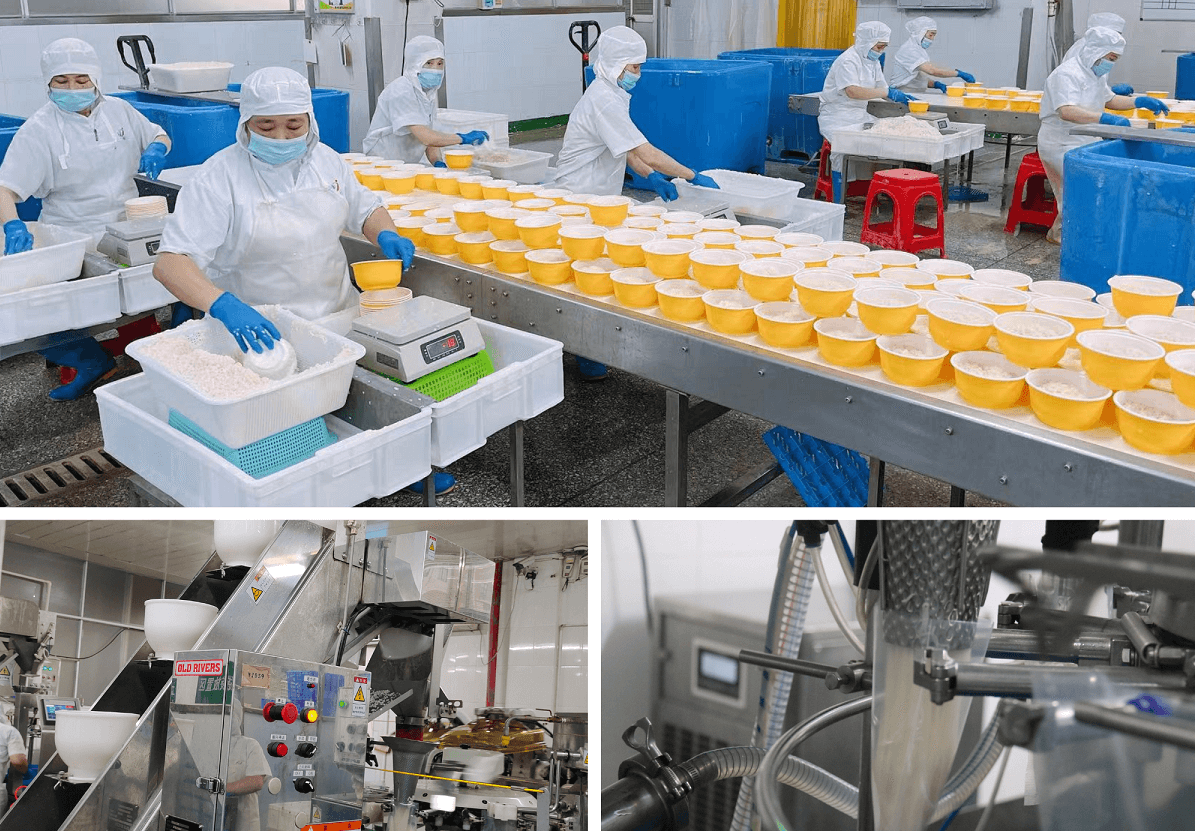
Our konjac rice manufacturing service can support:
OEM & Private Label
Customized Product Solutions
Customized Packaging
Multiple Package Formats
B2B Bulk Supply
Sample Development
Export-Oriented Documentation
Whether you are looking for a standard Konjac Dry Rice, Instant Konjac Rice, a differentiated formula or a new private label concept, the first step is to define your target product, package size and expected order volume.
Send us your target specifications, packaging preference and estimated quantity.
We can provide suitable OEM options, sample information and a factory quotation for your Indonesian market project.
You Might Also Like These
Post time: Sep-14-2026