

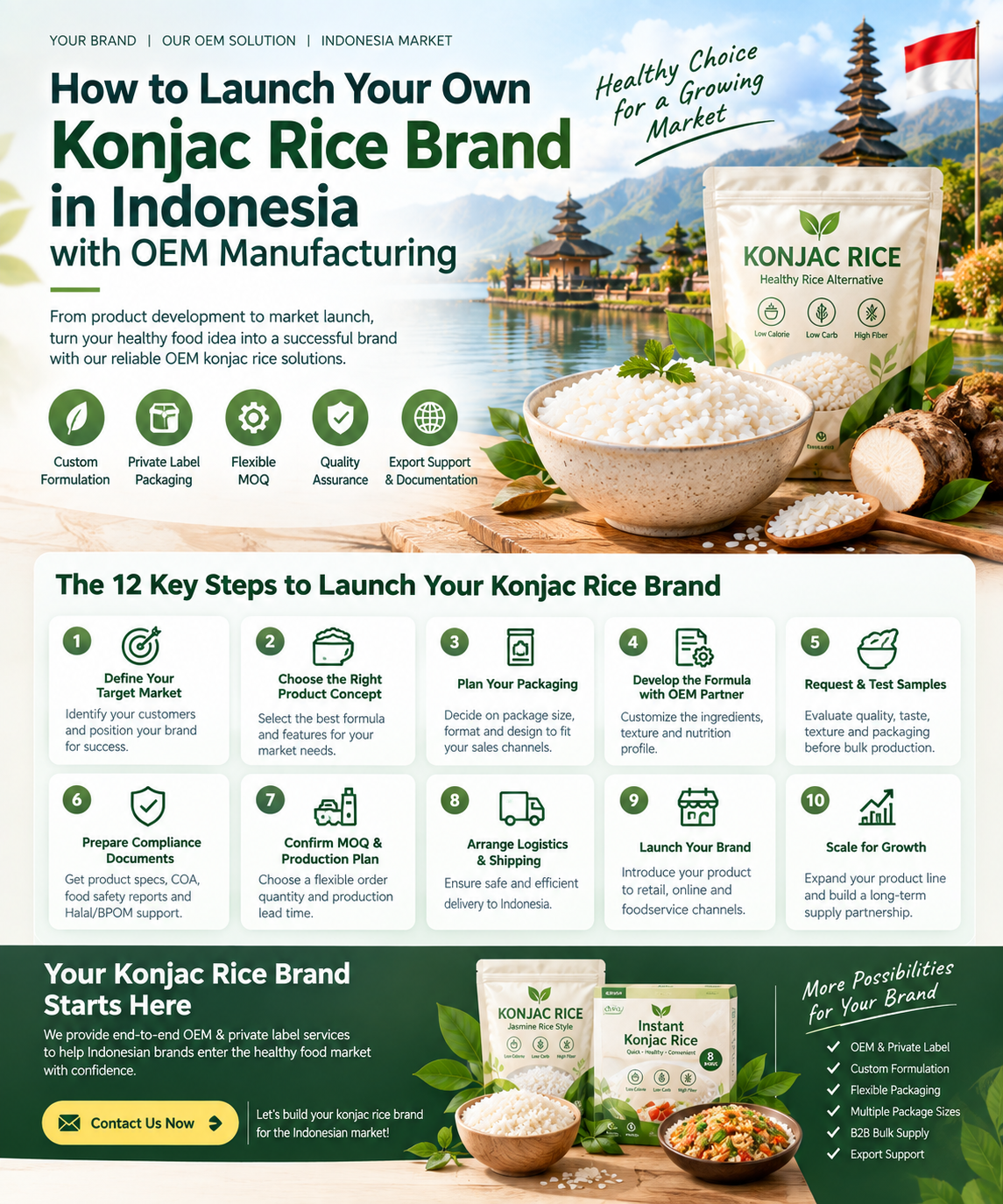
How to Launch a Konjac Rice Brand in Indonesia with OEM Manufacturing
Indonesia is becoming an increasingly interesting market for healthy and convenient food products. At the same time, the local market is already familiar with product concepts such as Beras Porang, Shirataki Rice and Konjac Rice.
For Indonesian food brands, this creates an important opportunity.
The question is no longer simply:
“Will consumers understand konjac rice?”
The more important question is:
“How can I launch a differentiated konjac rice brand without building my own factory?”
OEM manufacturing provides a practical solution.
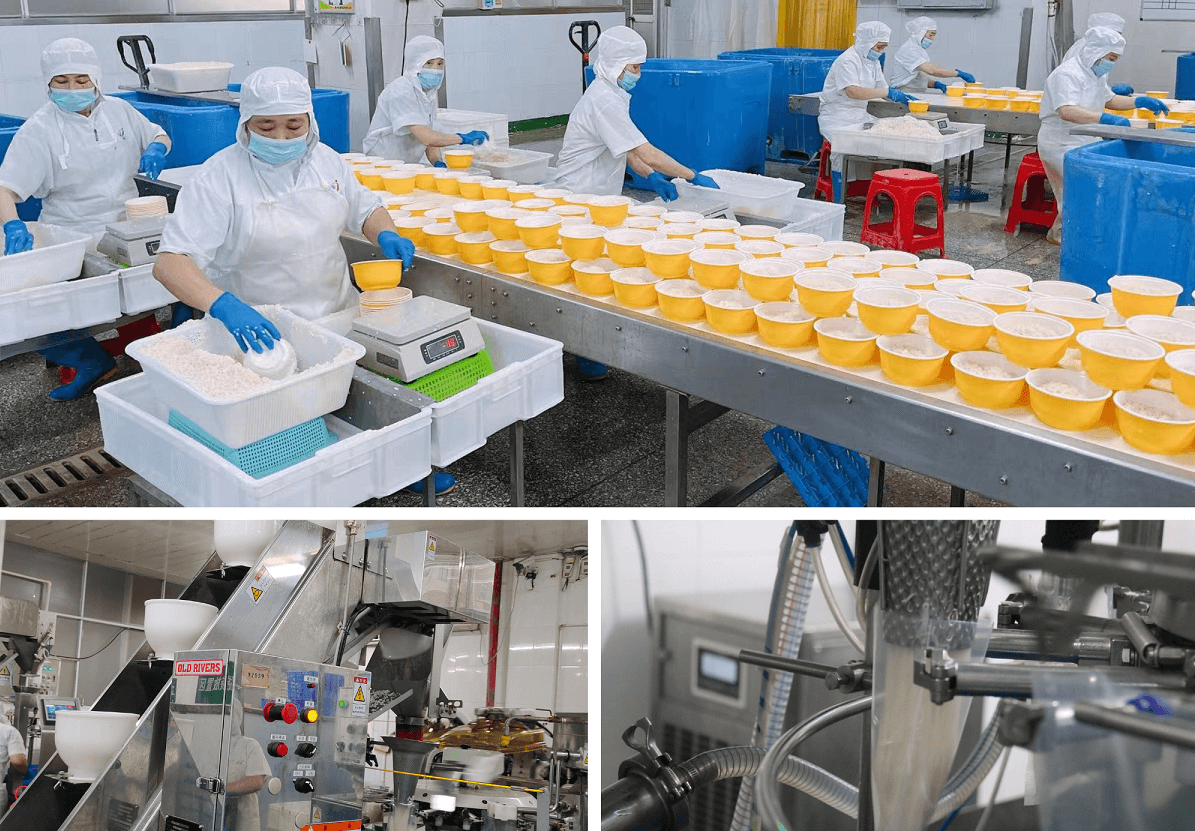
Instead of investing in production equipment, food-processing facilities and a complete manufacturing team, an Indonesian brand can work with an experienced konjac rice manufacturer to develop the product, customize the packaging and build its own brand.
But successful OEM development requires more than putting a logo on an existing product.
It starts with choosing the right market position.
1. Start with the Customer, Not the Product
One of the most common mistakes when launching a new healthy food brand is choosing the product first and searching for customers afterward.
A stronger approach is to identify the target customer first.
For example:
Diet & Weight Management Brands
These brands may prefer convenient portion-controlled formats and clear nutritional positioning.
Fitness & Active Lifestyle Brands
They may be interested in products that complement meal-preparation and active lifestyles.
Healthy Food Brands
They may need a broader product story around everyday healthier eating.
E-Commerce Brands
They may prioritize attractive packaging, trial-size products and convenient formats.
Distributors & Importers
They may focus more heavily on landed cost, MOQ, shelf life, documentation and supply stability.
The same konjac rice ingredient can therefore become very different commercial products depending on the target customer.
Your brand positioning should determine your OEM product—not the other way around.
2. Decide What Makes Your Konjac Rice Different
Indonesia already has products sold under categories such as Beras Porang, Shirataki and Konjac Rice.
That means launching another generic product can quickly lead to price competition.
A new brand needs a clear reason to exist.
Instead of simply selling:
“Konjac Rice 1kg”
you could explore a more specific product concept such as:
- Instant Konjac Rice
- Konjac Jasmine Rice
- High-Fiber Konjac Rice
- Low-GI Konjac Rice
- Multigrain Konjac Rice
- Chia Seed Konjac Rice
- Purple Sweet Potato Konjac Rice
- High-Protein Konjac Rice
- Single-Serve Konjac Rice
The objective is not to create the most complicated formula.
The objective is to create a product that is easy for your target customer to understand and easy for your sales team to differentiate.
3. Choose the Right Packaging Format for Your Sales Channel
Packaging should be decided together with the sales channel.
Indonesia's online market already shows different konjac rice formats, including 1kg products and individual sachets. Some products are also sold in multi-pack bundles, demonstrating how brands can use different formats for different purchasing occasions.
For an OEM project, you may consider:
Individual Sachet
Suitable for:
- Trial purchases
- Office meals
- Fitness consumers
- Portion-controlled products
- E-commerce bundles
100g–300g Retail Pack
Suitable for:
- Individual consumers
- New product trials
- Premium healthy-food brands
1kg Family Pack
Suitable for:
- Household consumption
- Supermarkets
- Distributors
- Wholesale channels
Multi-Pack Box
Suitable for:
- E-commerce
- Subscription products
- Gift sets
- Trial bundles
A good OEM supplier should help you compare packaging options instead of simply offering one standard package.
4. Develop the Product Around Indonesian Eating Habits
A product can be technically excellent but commercially weak if consumers do not know how to use it.
For Indonesia, konjac rice should not be positioned only as a “diet product.”
It can also be presented as a modern rice alternative for familiar meals.
Potential applications include:
Healthy Rice Bowls
Nasi Goreng
Chicken Rice Meals
Meal Prep
Fitness Meals
Office Lunches
Everyday Home Meals
This gives the brand more room to communicate with consumers.
Instead of saying:
“This is a special diet product.”
the brand can communicate:
“A convenient rice alternative that fits modern Indonesian meals.”
That positioning can make the product more accessible beyond a niche diet audience.
5. Build the Formula with Your OEM Manufacturer
Once the target positioning is clear, the next step is product development.
An OEM manufacturer should be able to discuss the actual product specification with you.
Key areas include:
- Ingredient formulation
- Grain appearance
- Texture
- Preparation method
- Portion size
- Flavor profile
- Nutritional profile
- Packaging compatibility
- Shelf-life requirements
For example, if the target is an instant product, preparation convenience becomes critical.
If the target is a premium family product, texture and eating experience may become more important.
If the target is an e-commerce trial product, portion size and packaging cost may have greater influence on the final product.
This is why simply asking:
“What is your cheapest konjac rice?”
is usually the wrong starting point.
A better question is:
“What product specification fits my target Indonesian customer?”
6. Request Samples Before Committing to Bulk Production
A sample should be treated as a commercial test.
Before confirming an OEM order, evaluate:
Appearance
Is the dry rice visually consistent?
Texture
Does the prepared product deliver the expected eating experience?
Aroma
Is the product aroma acceptable?
Preparation
Is the process simple enough for the intended customer?
Packaging
Does the package communicate the brand's positioning?
Customer Experience
Would you personally be comfortable putting this product under your brand name?
A good supplier should be able to discuss sample feedback and make reasonable adjustments before mass production.
7. Keep Your First Order Commercially Controlled
Launching a new food product always involves uncertainty.
Even if market research looks positive, actual customer response may differ.
That is why MOQ deserves serious attention.
Before placing an order, ask:
- What is the finished-product MOQ?
- What is the packaging MOQ?
- Is customized printing subject to a separate MOQ?
- Can different SKUs be combined?
- Can a trial order be arranged?
- What is the production lead time?
- How quickly can repeat orders be produced?
For a new Indonesian brand, the goal of the first order should be market validation, not simply purchasing the largest possible quantity.
Once sales become predictable, the brand can move toward larger production volumes and better supply economics.
8. Plan Indonesian Labeling and Compliance Before Printing the Packaging
This is an area where new brands should avoid last-minute changes.
Indonesia's BPOM provides specific requirements for processed-food labels, including product name, ingredients, net weight, producer/importer information, production code/date, expiry information and distribution permit information; halal information is required where applicable.
In addition, BPOM Regulation No. 10 of 2026 on nutrition information for processed-food labels is currently in force, replacing previous references on nutrition information.
This means product development and packaging design should be connected to the compliance process from the beginning.
Before final artwork approval, Indonesian buyers should work with their local regulatory/import team to confirm the requirements applicable to their specific product.
The OEM manufacturer should provide accurate product specifications and supporting documents rather than making assumptions about local registration.
Do not print thousands of packages before checking the regulatory requirements.
This simple step can prevent expensive packaging revisions.
9. Calculate Landed Cost Instead of Comparing Factory Prices
A successful Indonesian food brand needs more than an attractive factory quotation.
Your real business calculation should consider:
OEM Product Cost
Custom Packaging
Export & Handling Costs
International Freight
Import-Related Costs
Local Distribution
=
Estimated Landed Cost
This number should then be compared with your intended:
Distributor Price
Wholesale Price
Retail Price
and
E-Commerce Selling Price
A supplier with the lowest factory price is not automatically the supplier with the best commercial solution.
Packaging efficiency, MOQ, quality consistency, production lead time and product positioning can all influence your final margin.
10. Build a Brand Architecture That Can Grow
Do not build your business around one SKU if you intend to develop a long-term healthy-food brand.
A more scalable approach is:
Stage 1
Hero Product
Konjac Dry Rice
↓
Stage 2
Convenience Product
Instant Konjac Rice
↓
Stage 3
Functional Variants
High-Fiber / Low-GI / Multigrain / Customized Formulas
↓
Stage 4
Broader Konjac Portfolio
Konjac Noodles / Konjac Snacks / Other Healthy Food Products
This approach allows the brand to test the market before investing heavily in a large product portfolio.
The OEM supplier becomes more valuable when it can support this expansion.
11. Choose a Manufacturer That Can Grow with Your Brand
When selecting a supplier, do not evaluate only today's order.
Ask yourself:
Can this supplier support me after my first successful launch?
Look for capabilities such as:
- OEM & ODM development
- Private label manufacturing
- Customized formulas
- Flexible packaging options
- Quality-control systems
- Product testing
- Export experience
- Documentation support
- Stable production capacity
- New product development
- Long-term B2B supply
The first order may be 500 or 1,000 units.
The real value of a supplier is whether they can support you when your business reaches 10,000, 50,000 or more units.
12. A Practical 6-Step OEM Launch Process
Launching a private label konjac rice brand does not need to be complicated if the project is structured correctly.
Step 1 — Define Your Target Market
Decide whether you are targeting:
Diet consumers / Fitness / Healthy families / E-commerce / Supermarkets / Distributors
Step 2 — Select the Product Concept
Choose the appropriate:
Formula + Portion + Preparation Method + Positioning
Step 3 — Request Samples
Test product quality and collect internal feedback.
Step 4 — Confirm Packaging
Develop:
Brand Design + Product Information + Packaging Format + Label Content
Step 5 — Confirm Commercial Terms
Finalize:
MOQ + Price + Lead Time + Payment Terms + Shipping Arrangement
Step 6 — Launch and Scale
Start with a controlled order, collect market feedback and optimize the product before increasing production.
This approach allows Indonesian brands to reduce unnecessary risk while keeping room for future growth.
Why OEM Manufacturing Can Be a Smarter Entry Strategy
Building a food factory requires substantial investment in:
- Production equipment
- Facility management
- Food safety systems
- Skilled workers
- Quality control
- Packaging equipment
- Raw material sourcing
- Regulatory management
For a brand whose core strength is marketing, sales and distribution, owning the entire manufacturing infrastructure may not be necessary.
OEM manufacturing allows the brand to focus on what it does best:
Build the brand.
Develop the market.
Acquire customers.
Expand distribution.
While the manufacturing partner focuses on:
Product development.
Production.
Quality control.
Packaging coordination.
Supply.
That division of expertise can create a more efficient route to market.
Why OEM Manufacturing Can Be a Smarter Entry Strategy
The best OEM project usually begins before the purchase order.
A conversation with the manufacturer can help clarify:
- Which product format fits the target customer
- Which packaging format is commercially practical
- What MOQ is realistic
- Which product variations are possible
- What documents are available
- How samples can be developed
- How the product can scale after launch
This can prevent one of the most expensive mistakes in private label food:
Producing a product first and discovering the market problem later.
Ready to Launch Your Own Konjac Rice Brand in Indonesia?
If you are an Indonesian importer, distributor, food brand, supermarket supplier or e-commerce seller, our OEM team can help you develop a konjac rice product around your target market.
We support:
OEM & Private Label Konjac Rice
Customized Product Development
Custom Packaging
Multiple Package Formats
Sample Development
Flexible B2B Supply
Export-Oriented Documentation
From a simple Konjac Dry Rice project to an Instant Konjac Rice, customized formula or multi-SKU healthy-food portfolio, we can discuss the product according to your target customers, packaging requirements and expected order volume.
Start with Your Product Idea
Send us:
1. Target Product
2. Package Size
3. Estimated Order Quantity
4. Preferred Packaging
5. Target Market Positioning
We can then discuss suitable OEM options, sample development, packaging solutions and factory quotation for your Indonesian market.
Build your own konjac rice brand.
Start with the right product. Scale with the right manufacturing partner.
You Might Also Like These
Post time: Sep-16-2026